


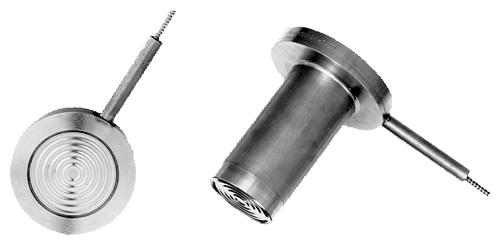
The measured pressure is transferred from the diaphragm to the filling liquid and passes through the capillary to the measuring chamber of the pressure transmitter. The interior of the diaphragm seal and of the capillary, as well as the measuring chamber of the transmitter, are filled gas-free by the filling liquid. Transmission responseThe transmission response of a remote seal is characterized by the following variables:
Temperature error Temperature errors are caused by the change of volume of the filling liquid due to temperature variations. To select the right remote seal you must calculate the temperature error. Below you will find an overview of the factors which influence the size of the temperature error, as well as information on how to calculate the temperature error. The temperature error is dependent on the following variables:
Diaphragm rigidity The rigidity of the diaphragm is of decisive importance. The bigger the diameter of the diaphragm, the softer the diaphragm and the more sensitively it reacts to temperature-induced changes in volume of the filling liquid. The result is that small measuring ranges are only possible with large diaphragm diameters. Other factors apart from diaphragm rigidity which also play a role:
Filling liquid Every filling liquid reacts to temperature variations with a change of volume. Temperature errors can be minimized by selecting a suitable filling liquid, but the filling liquid must also be appropriate for the temperature limits and operating pressure. Furthermore, the filling liquid must also be physiologically harmless. Since the filling liquid is present under the diaphragm, in the capillary and under the process flange of the pressure transmitter (or in the connection shank), the temperature error must be calculated separately for each combination. Note: When operating in the low-pressure range, also during commissioning, it is recommended to use a vacuum-proof remote seal (see Selection and Ordering data). An example of a temperature error calculation can be found in the section "Technical Specifications". Response time The response time is dependent on the following factors:
RecommendationsThe following should be observed to obtain an optimum combination of transmitter and remote seal:
NoteThe remote seals listed here are a selection of the most common designs. On account of the large variety of process connections, certain remote seals which are not listed here may be available nevertheless. Other versions can be:
Please contact your Siemens Regional Office for more information.
|
| Каталог 2018 | Каталог 2017 | Каталог 2016 | Каталог 2015 | Каталог 2014 | Каталог 2013 | Каталог 2012 | Сертификат | Контакты | Карта сайта | Поиск |