


? Error curves of rotary-piston metersThe shape of the error curve is also affected by the viscosity of the metered liquid. The error in measurement increases with decreasing viscosity, especially at the beginning and towards the end of the flow rate range. By appropriate regulation, i.e. changing a pair of gear-wheels between the meter mechanism and the register, the position of the error curve can be displaced parallel to the zero line and thus the meter can be optimally calibrated. The appropriate pair of replacement gears can be read off from a table or determined with the aid of a calculating disk. The illustration “Error curves of volumetric meters” shows error curves without any regulation having been carried out. 
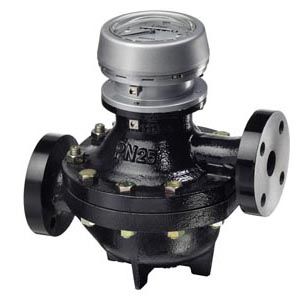
Error curves of volumetric meters dependent in shape and location on the flow rate and the viscosity of the liquid Note: 1 mPa·s = 1 cp Measuring accuracyThe rotary-piston meters are approved in the European Community and in many other countries for the custody transfer. The following error limits apply between 0.2 % and 0.5 % of the correct value (depending on the liquid, the measuring range and the relevant calibration specifications). The stated error limits in % of the correct value apply to the whole flow rate and for any delivery quantity greater than the smallest permissible quantity. This is an important difference compared to other measuring instruments whose errors are related to the full-scale value and thus only reach the stated accuracy at one point - full-scale deflection. The minimum flow rate should not fall below 10 % of the maximum flow rate in order to remain within the stated accuracy limit. This explains why the usual flow rate range for volumetric meters is 1:10. Note: The measuring system of the rotary-piston meter must always be filled with the liquid to be measured in order to achieve a high measuring accuracy. NoteThe material combinations which can be supplied are listed in the Selection and Ordering data. Service life (long-term accuracy)The service life of a volumetric meter, i.e. the operating time until an overhaul or recalibration becomes necessary, is determined by the mechanical abrasion of the moving parts of the mechanisms which occurs because of forces from the metered liquid. As well as the nature of the materials used (running characteristics), the service life is dependent on the lubricating properties of the metered liquid, the service is dependent on the lubricating properties of the metered liquid, the daily operating time and the cube of the flow rate (speed of rotation). The last factor is one of the reasons why only half of the maximum flow rate specified for the batch operation is permissible for continuous operation. Since the above factors can hardly be determined exactly with industrial use of the meter, unequivocal statements on the service life (long-term accuracy) are not possible. Recalibration is required every two years by law (in Germany) for meters used for custody transfer. On the basis of this regulation, it is recommended that meters which are not used for custody transfer be checked and recalibrated if necessary, at intervals of two to three years. Even this recommendation is based on average, “normal” operating conditions. A period of three years is too short, for example, for a meter used for the batch dispensing of lubricating oil, it will still work within the stated error limits even after five years or more. Rotary piston meters - Configurations
|
||||||||||||||||||||||||||||||||||||||||||||||||||||||||||||||||||||||||||||||||||||||||||||||||||||||||||||||||||||||||||||||||||||||||||||||||||||||||
| Каталог 2018 | Каталог 2017 | Каталог 2016 | Каталог 2015 | Каталог 2014 | Каталог 2013 | Каталог 2012 | Сертификат | Контакты | Карта сайта | Поиск |


