


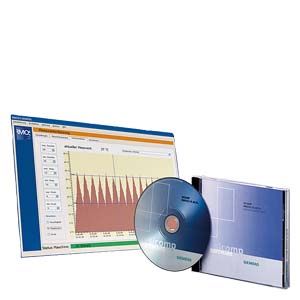
? Symmetric Multicore Processing (SMP) for maximum performance on Core i processorsRMOS3 V3.50 now also supports Core i processors with up to 2 cores/4 threads thanks to the new Symmetric Multicore Processing (SMP) mode. This mode makes it possible to implement complex applications that are simultaneously processed on multiple processor cores. RMOS3 V3.50 ensures that the cores are symmetrically utilized so that a performance increase of up to 100% can be achieved on the SIMATIC IPC with two cores. A second PC, e.g. for visualization, can be omitted without performance loss. Taking into account the compatibility of existing applications, it can also be specifically connected to one core if required. Additional commands allow the implementation of the entire application to be limited to one individual core in order to avoid effects such as deadlocks or CPU hopping without changing the tried-and-tested application. Memory protection for high system availabilityThe memory protection functionality for RMOS3 offers even more reliability for execution of the user applications created from RMOS3-GNU V3.0 using the development tools. The applications are started in a separate execution level through a privilege level mechanism and their memory accesses are managed by the operating system. The operating system code, data and stack are therefore protected from unauthorized access from user programs. This ensures reliable execution of the operating system. "Paging" mechanisms also protect the code areas of internal and external applications. This ensures reliable execution of all parts of the application and, in the event of an error, rapid localization of the actual cause. Time-consuming troubleshooting can therefore be avoided. This applies in particular to the new stack monitoring mechanism. It detects unauthorized exiting of the valid stack area. Unwanted memory accesses are therefore prevented. Null-pointer detection prevents the use of uninitialized pointer variables. Every access to the lowest page of the memory is detected. A page fault exception supports rapid error localization. More ruggedness and industrial suitabilityHigh Precision Event Timers (HPET), which are available on all B devices of the SIMATIC IPC product range, enable a long-term accurate time output for logging time events under RMOS3 V3.50. In continuous operation (24/7), the deviations of the system time per week can be reduced to approx. 9 seconds, this means a 90% reduction compared to the standard timer. A further reduction of the minimum task cycle times from 50 µs to 10 µs allows for even faster control cycles on a task level. High level of user-friendliness and serviceabilityFor the "post mortem" analysis of defective applications, additional information on the crash site is issued. It can be used to localize the relevant area in the source code without having access to the defective system. This makes for fast troubleshooting without having to expend time and energy to reproduce the error or call a software specialist to the site. Troubleshooting does not interfere with production at the end customer and sporadic errors can be analyzed at the developer's office. Temporary files can be temporarily stored with version V3.50 on a virtual hard drive (up to 2 GB). The limit of 32 MB no longer exists and performance of the RAM disk driver has been further increased. This means that large data volumes can be collected during production and, if needed, transmitted via FTP to higher-level stations for further analysis. Additional expansions to the RMOS3 V3.50 user console permit complete directory trees to be rapidly deleted and applications with up to 64 arguments to be started. For users and service personnel, the expanded, configurable RMOS3 nucleus for SIMATIC IPC offers greater convenience and shorter start-up times. Apart from the already familiar additional functions of the nucleus, such as easy configuration using the initialization file (RMOS.INI) or user-friendly adjusting of serial and LAN interfaces, the following expansions are available:
A number of additional functions make it suitable for different hardware versions:
The configurable nucleus is optimally prepared for additional hardware features. This supports fast and reliable implementation for the customer's application:
Moreover, the configurable nucleus offers the following functions:
The configurable nucleus already contains TELNET and FTP services for easy and low-cost remote maintenance of the target system over TCP/IP. This allows debugging and software updates both during the development and production phase. Additional functions for optimal use of the operating system resources:
|
| Каталог 2018 | Каталог 2017 | Каталог 2016 | Каталог 2015 | Каталог 2014 | Каталог 2013 | Каталог 2012 | Сертификат | Контакты | Карта сайта | Поиск |