


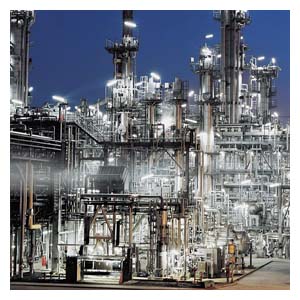
In many industrial and public sectors, explosion protection or explosion hazards are ever-present, e.g. in the chemicals industry, in refineries, on drilling platforms, at petrol stations, in feed manufacturing and in sewage treatment plants. The risk of explosion is always present when gases, fumes, mist or dust are mixed with oxygen in the air in an explosive ratio close to sources of ignition that are able to release the so-called minimum ignition energy. In the chemical and petrochemical industries in particular, when crude oil and natural gas are transported, or in mining, milling (e.g. grain and solids), this can result in serious injury to persons and damage to equipment. To ensure maximum safety in these areas, legislators in most countries have implemented appropriate stipulations in the form of laws and regulations based on national and international standards. Explosion-protected equipment are designed such that an explosion can be prevented when they are used properly. The explosion-protected equipment can be designed in accordance with various types of protection. The local conditions must be subdivided into specified zones by the user with the assistance of the responsible authorities in accordance with the frequency of occurrence of an explosion hazard. Device (equipment) categories are assigned to these zones. The zones are then subdivided into possible types of protection and therefore into possible equipment (product) types. Classification of zonesAreas subject to explosion hazard are divided into zones. Division into zones depends on the chronological and geographical probability of the presence of a hazardous, potentially explosive atmosphere. Information and specifications for classification of the zones are laid down in the following standards:
Further, a distinction is made between various explosion groups as well as temperature classes and these are included in the hazard assessment. 
Depending on the particular zone and therefore the associated hazard, operating equipment must comply with defined minimum requirements regarding the type of protection. The different types of protection require corresponding measures to prevent ignition that should be implemented at the motor in order to prevent that a surrounding explosive atmosphere is ignited.
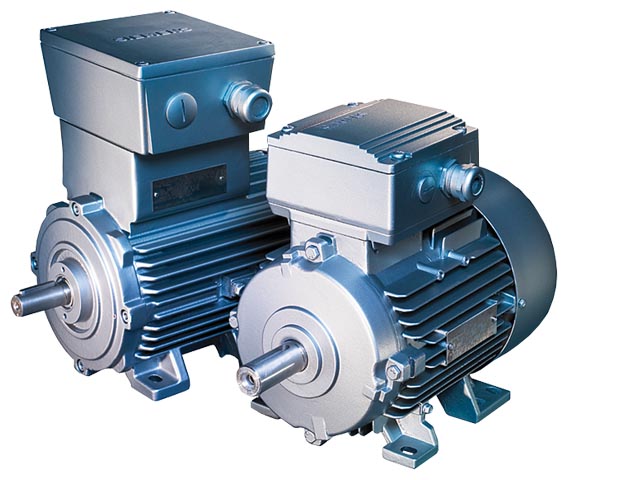
1) Motors of - Zone 1 can also be used in Zone 2 - Zone 21 can also be used in Zone 22 2) Motors which are certified for gas or dust protection must not be used in hybrid mixtures! Hybrid mixtures: When explosive gas and dust atmospheres occur simultaneously. Types of protectionType of protection "Increased safety" Ex e acc. to IEC/EN 60079-7 Additional measures are taken to prevent the possibility of high temperatures and to prevent sparks or arcs from occurring on the inside and on external components of the motor. Motors of the 1MA6 and 1MA7 series are designed with "Increased safety". Type of protection "Explosion-proof enclosure" Ex d acc. to IEC/EN 60079-1 The components that can ignite an explosive atmosphere are located in an enclosure that is not damaged by an internal explosion and flameproof joints prevent flames from escaping to the explosive atmosphere on the outside. Motors of the 1MJ6 and 1MJ7 series are designed with "Explosion-proof enclosure". Type of protection "Non-sparking" Ex nA acc. to IEC/EN 60079-15 The type of protection Ex nA ensures that a motor in normal operation as well as when operated under deviating conditions as specified in the standard is not in a position to ignite a surrounding explosive gas atmosphere. Motors of the 1LA and 1LG series are optionally available in Ex nA design. Type of protection "Dust explosion protection" Ex tD acc. to IEC/EN 61241 This type of protection applies for electrical equipment protected using an enclosure and with limited surface temperature for use in areas in which combustible dust can occur in concentration levels that could cause a fire or an explosion. Motors of the 1LA and 1LG series are optionally available in Ex tD design. Explosion-proof motors for converter-fed operation Principally, explosion-proof motors (except for Ex e) can be fed from converters. Particular attention must be paid to the interaction between the motor and converter system, especially with regard to the following aspects:
CertificationIEC motors for use in hazardous zones are certified according to the EU Directive 94/9/EG (ATEX) and are marked according to the following schematic:
Additional information on the subject of explosion protection, types of protection and zones is provided in the Siemens brochure "Explosion Protection". Overview of SIMOTICS XP 1MA/1MJ/1LA/1LG Explosion-Proof MotorsThe table below contains a complete overview of our products, their types of protection and the assignment of motor types to categories. It is important to note that depending on whether the motor is used for converter-fed operation or mains-fed operation, different order codes are required for unique selection of the required product.
1) Highest explosion group IIC includes IIB and IIA. Optionally with Ex d connection box (order code K53). 2) 1PQ8 is not possible for Zone 21. Zone 2 and 22 for 1PQ8 available on request. Utilization according to temperature class 155 (F). 3) See EC type test certificate. 4) 1LA8 only available for Zone 22 (order codes M35, M39). Converter: Utilization as standard according to temperature class 155 (F). 5) The explosion-proof motor is not admissible in an explosive atmosphere of gas and dust (hybrid). A standard is not currently available that describes the product requirements for a hybrid mixture. Spectrum of 1LA/1MA Explosion-Proof Motors
1) Zone 2 Ex nA II is not possible for 1LA5 motors; for Zone 2 Ex nA II, 1LG4 motors are available. 2) Zone 2 Ex nA II is not possible for 1LA9 motors in frame sizes 180 and 200. Spectrum of 1LA/1LG/1MA/1MJ Explosion-Proof Motors
1) Zone 21 Ex tD is not possible for 1LA6 motors. 2) Order identically priced predecessor type for 1LG6...2AA../ 1LG6...2AB.. 2-pole motors or 1LG6...4AA.. 4-pole motors using the options for country certificates, marine certificates, explosion-proof version and IE3 version. For 1LG6318-.M.. and 1LG6312-.M.. motors, it is not possible to use the options for country certificates, marine certificates, explosion-proof version, brakes, low-noise version and separately driven fan.
|
||||||||||||||||||||||||||||||||||||||||||||||||||||||||||||||||||||||||||||||||||||||||||||||||||||||||||||||||||||||||||||||||||||||||||||||||||||||||||||||||||||||||||||||||||||||||||||||||||||||||||||||||||||||||||||||||||||||||||||||||||||||||||||||||||||||||||||||||||||||||||||||||||||||||||||||||||||||||||||||||||||||||||||||||||||||||||||||||||||||||||||||||||||||||||||||||||||||||||||||||||||||||||||||||||||||||||||||||||||||||||||||||||||||||||||||||||||||||||||||||||||||||||||||||||||||||||||||||
| Каталог 2018 | Каталог 2017 | Каталог 2016 | Каталог 2015 | Каталог 2014 | Каталог 2013 | Каталог 2012 | Сертификат | Контакты | Карта сайта | Поиск |